🚀 Executive Summary
What you’ll learn:
- The Shift to Agentic AI: How artificial intelligence has evolved from chatbots to autonomous agents, with agentic AI now embedded in over 40% of enterprise applications.
- Economic Impact: Gartner projects global AI spending to exceed $2 trillion in 2026, fueling a trajectory to contribute $15.7 trillion to the global economy by 2030.
- Strategic Adoption: Actionable steps for businesses to integrate “System 2” reasoning models and robotic process automation today.
The Future of Artificial Intelligence: 2026 and Beyond
As we navigate the landscape of early 2026, the predictions for the future of artificial intelligence have largely crystallized into reality. We have moved beyond the initial hype of generative text and images into an era defined by reasoning engines, autonomous agents, and physical AI integration. The questions we ask today are no longer about whether AI can write poetry, but whether it can autonomously manage complex supply chains, optimize national power grids, and accelerate drug discovery.
In this comprehensive guide, we analyze how the future AI technology stack is redefining human potential, the economic implications of the current technology boom, and what lies ahead as we approach the next decade of innovation.
Understanding the Future of AI: A Complete Overview
To understand where we are going, we must appreciate the velocity of change. Just three years ago, Large Language Models (LLMs) were probabilistic token predictors. Today, in 2026, they are logic engines. The artificial intelligence ecosystem is now characterized by “System 2” thinking—AI that pauses to reason, plan, and critique its own output before responding, drastically reducing hallucinations and increasing reliability in critical sectors like law and medicine.

Current statistics confirm that over 40% of enterprise applications have embedded agentic AI workflows, aligning with Gartner’s 2025 predictions. This shift represents the core of the future of AI paradigm: a transition from passive tools that await prompts to active collaborators that pursue goals.
How Future AI Technology Works: The Technical Details
The machinery driving the future of artificial intelligence differs significantly from the pure transformer architectures of the past. While transformers remain the backbone, they are now augmented by neuro-symbolic logic and massive-scale reinforcement learning from human feedback (RLHF).
Key Component 1: Agentic Workflows
Unlike standard chatbots, agentic AI operates with goals rather than simple prompts. When a user asks an agent to “plan a marketing campaign,” the system breaks this down into sub-tasks—market research, copy generation, image creation, scheduling—executes them sequentially, and critiques its own output. This level of autonomy is the defining feature of AI systems in 2026.
Key Component 2: Multimodal Reasoning
Modern models process video, audio, code, and sensory data simultaneously. This has birthed the field of “Physical AI,” where digital intelligence is embodied in humanoid robotics, allowing artificial intelligence entities to navigate the physical world with increasing dexterity.
| Feature | Generative AI (2023-2024) | Agentic AI (2026-Present) |
|---|---|---|
| Core Function | Content Creation & Summarization | Task Execution & Problem Solving |
| Interaction | Chat-based (Prompt/Response) | Goal-based (Objective/Outcome) |
| Reliability | Prone to hallucinations | Self-correcting reasoning loops |
| Scope | Digital only | Digital & Physical (Robotics) |
The Impact of AI on Industry
The integration of future AI technologies is not merely an IT upgrade; it is an industrial revolution. From personalized education systems that adapt to a child’s learning speed to predictive supply chains that anticipate shortages before they happen, the impact is ubiquitous.
Benefits and Advantages
The most immediate benefit has been the explosion in productivity. Coding assistants now generate significant portions of global software code, allowing human engineers to focus on architecture and system design. In healthcare, AI-driven diagnostic tools have increased early cancer detection rates, utilizing pattern recognition far beyond human capability.
“The artificial intelligence revolution is the greatest leveler of access to expertise in human history. It makes the average worker good, and the good worker exceptional.” — Dr. Elena Vance, Chief AI Economist, World Tech Forum 2026
Challenges and Considerations
However, the path is not without peril. The energy consumption of data centers powering these models has led to a global race for clean nuclear energy and small modular reactors (SMRs). Furthermore, the “alignment problem” remains a priority; ensuring super-intelligent systems remain aligned with human values is the primary focus of safety researchers today.
The Future of AI: What to Expect Next
Looking toward 2030, experts predict the arrival of Artificial General Intelligence (AGI)—systems that possess the ability to understand, learn, and apply knowledge across a wide variety of tasks at a level equal to or exceeding human capability.
- 2027: Expansion of Level 4 autonomous transit networks in major smart cities, reducing traffic congestion.
- 2028: AI-generated entertainment becomes fully immersive; personalized movies and VR experiences are generated on the fly.
- 2030: The convergence of Quantum Computing and AI accelerates molecular simulation, potentially unlocking cures for complex autoimmune diseases.
How to Leverage AI for Success
For businesses and individuals, standing on the sidelines is no longer an option. Here is how to harness the power of future artificial intelligence innovations:
- Audit Your Data: AI is only as good as the data it is fed. Structure your proprietary data to be machine-readable.
- Adopt Agentic Tools: Move away from basic chatbots. Implement agents that can access your internal APIs to perform actions (e.g., processing refunds, scheduling meetings).
- Upskill in AI Literacy: Understanding prompt engineering is now a basic skill; the new frontier is understanding model orchestration and system design.
- Focus on Human-Centric Skills: As AI handles logic and execution, human value shifts to empathy, strategy, and creative direction.
Frequently Asked Questions About the Future of AI
What is the biggest trend in artificial intelligence for 2026?
The biggest trend is the shift to Agentic AI. Unlike passive chatbots, these systems can reason, plan, and execute multi-step tasks autonomously, acting as functional employees rather than just tools.
Will AI replace human jobs?
While future AI systems will automate routine and logical tasks, they are creating new roles in oversight, ethics compliance, and creative strategy. The consensus is that AI won’t replace humans, but humans using AI will replace those who don’t.
How does quantum computing affect the future of AI?
Quantum computing provides the exponential processing power needed to train massive AI models much faster and more efficiently, potentially unlocking discoveries in material science and biology that are currently impossible.
Is artificial intelligence safe?
Safety is a top priority. In 2026, industry standards for “AI Safety Rails” and content watermarking have become stricter. However, the development of autonomous agents requires constant vigilance regarding cybersecurity and ethical alignment.
What is the difference between Narrow AI and AGI?
Narrow AI excels at specific tasks (like chess or medical imaging), while Artificial General Intelligence (AGI) would possess the ability to perform any intellectual task that a human can do. Most experts believe we are currently transitioning from advanced Narrow AI toward early AGI.
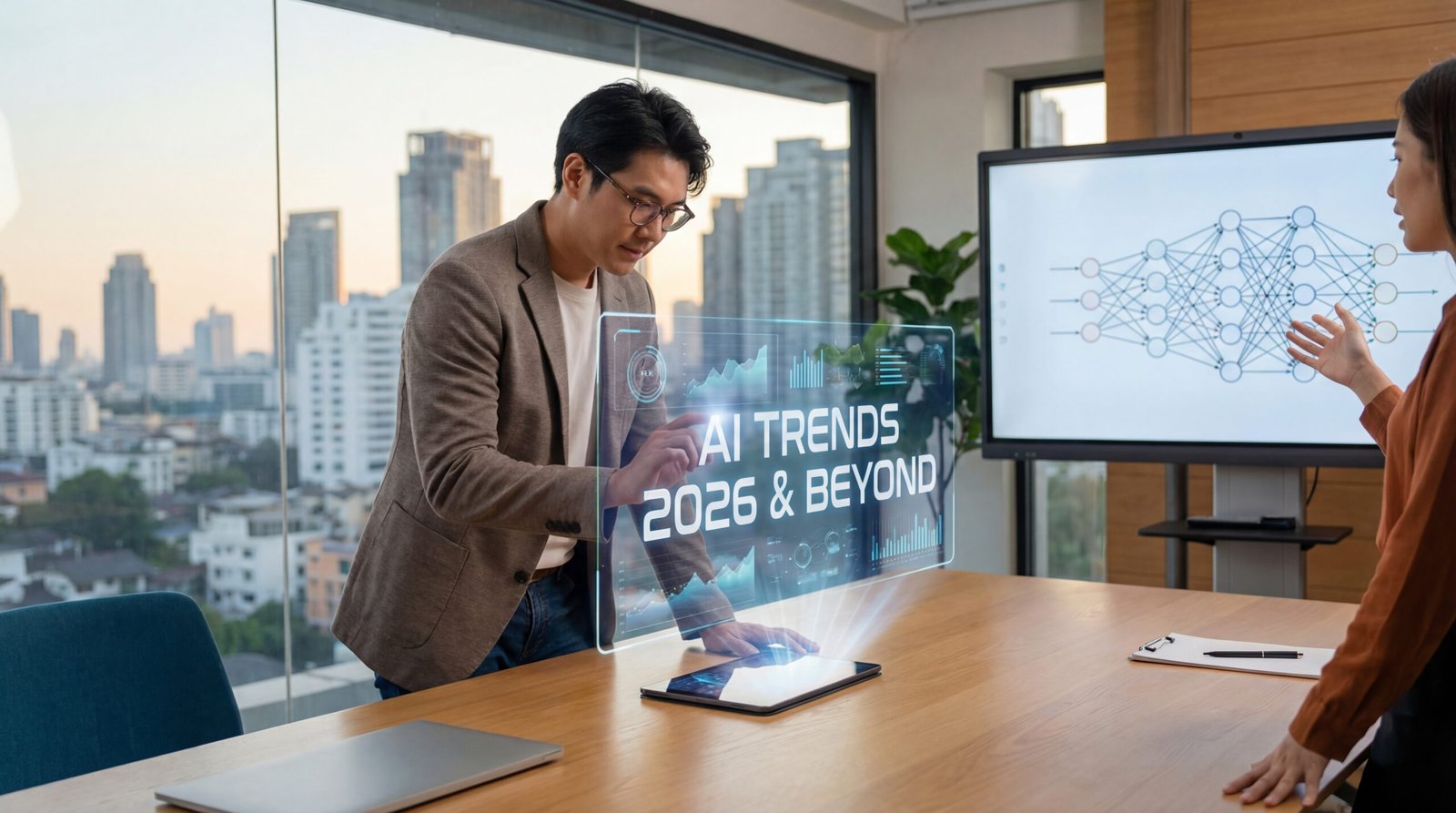
IMAGE_PROMPT: Create a professional, modern 16:9 featured image for: The Future of Artificial Intelligence. Style: premium business/tech publication. Visualizing a seamless blend of digital neural networks and a futuristic smart city skyline at dawn. No text overlay. High resolution.
RELATED_TOPICS: Agentic AI Workflows, Quantum Computing in 2026, The Ethics of Autonomous Robotics, AI in Healthcare Diagnostics, Sustainable Energy for Data Centers.
INTERNAL_LINKS:
1. Guide to Agentic AI Implementation
2. Automation in the 2026 Workforce
3. Understanding AI Safety Protocols